BLOG
Top Metal Detector for Pharmaceutical Industry?
Selecting the top metal detector for pharmaceutical industry operations requires more than comparing sensitivity figures. It demands evidence, validation, and process knowledge. A detector beside a tablet press may face vibration, dust, temperature changes, and dense product effects. A liquid line creates different challenges. Small details matter.
The FDA’s Process Validation Guidance recommends a lifecycle approach based on scientific evidence and ongoing process monitoring. Its Data Integrity and Compliance With Drug CGMP guidance also emphasizes reliable, traceable records. EU GMP Annex 15 supports documented qualification and validation before routine use. These principles shape a practical evaluation: detection capability, reject confirmation, hygienic design, audit trails, and integration with line controls.
Look closely at the test pieces.
A qualified system should challenge ferrous, non-ferrous, and stainless-steel standards across realistic product conditions. It should confirm that a rejected capsule or tablet cannot quietly re-enter production. Stainless-steel 316L contact surfaces, tool-free cleaning, and protected sensors can reduce maintenance risks. However, no detector is automatically “best.” Product conductivity, packaging, line speed, and installation geometry can change performance. This is where many comparison articles become too confident.
A stronger selection process combines supplier data with site trials, calibrated test standards, and documented acceptance criteria. ISPE and PDA technical guidance consistently promote risk-based qualification, control strategies, and continued verification. Operators should also review false-reject trends, alarm records, and preventive-maintenance results.
The final choice should be defensible.
It should protect product quality without creating unnecessary waste or inspection gaps. In pharmaceutical manufacturing, the best detector is not merely the most sensitive model. It is the system that performs consistently, records clearly, and remains reliable after installation.
Pharmaceutical Metal Detectors: Purpose and Operating Principles
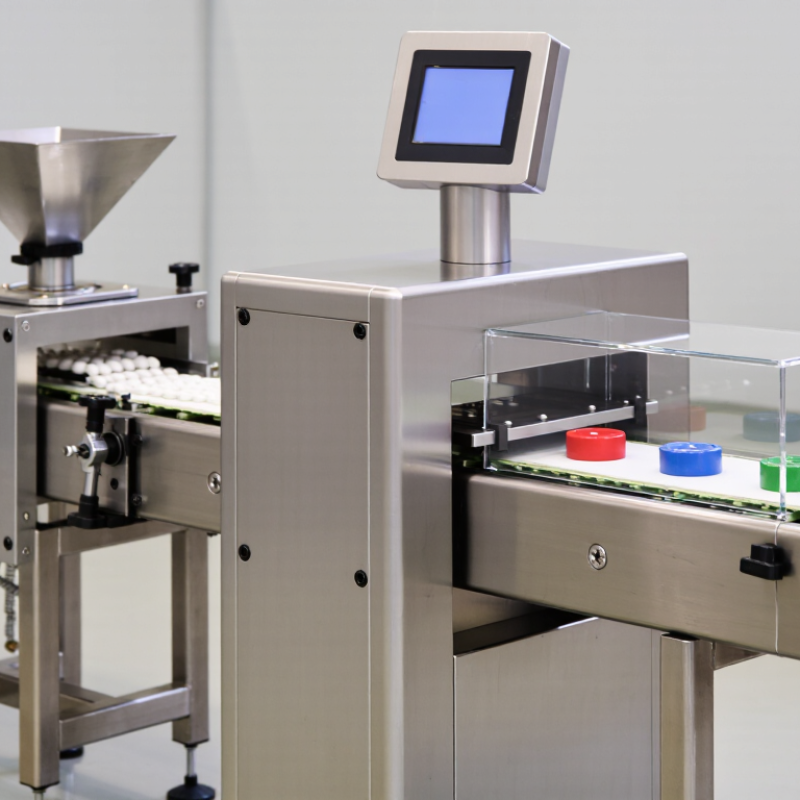
A pharmaceutical metal detector protects product quality by finding metallic particles before tablets, capsules, or powders leave controlled production. It does not replace GMP controls. FDA drug recall records repeatedly identify foreign matter as a quality concern, while ICH Q9(R1) requires risks to be assessed through science and patient impact.
The operating principle is electromagnetic. A transmitter creates a balanced field inside the aperture. Metal entering that field changes the signal, and software triggers an alarm or rejects the affected product. Ferrous, non-ferrous, and stainless-steel particles behave differently.
Typical validated targets may approach 0.3 mm for ferrous metal, 0.5 mm for non-ferrous metal, and 0.7 mm for stainless steel, according to inspection guidance from ISPE. These figures are not universal guarantees.
Validation needs real products, not only empty-aperture tests. Product conductivity, moisture, salt content, temperature, speed, and package material can reduce sensitivity. A 2023 PMMI pharmaceutical-packaging trends report also highlights inspection automation as a continuing investment area. Still, automation can create false confidence. I would challenge every clean result with certified test pieces, worst-case samples, and documented challenge frequency. Operators should record failed tests, investigate root causes, and verify reject devices physically. A detector is only reliable when its signals, alarms, records, and maintenance actions remain trustworthy.
Key Detection Requirements in Pharmaceutical Manufacturing
The top metal detector for the pharmaceutical industry must match the product, process, and contamination risks. Detection requirements begin with sensitivity. The system should identify ferrous, non-ferrous, and stainless-steel particles at validated sizes. Product conductivity can reduce performance, especially in wet powders, saline solutions, or coated tablets. Test pieces must reflect the real product and packaging conditions.
Hygienic design is equally important. Smooth surfaces, sealed connections, and tool-free access help reduce residue. The detection aperture should fit the line without creating unnecessary space.
A reliable reject device must remove contaminated products automatically. It should also stop production when rejection fails, air pressure drops, or the detector reports an internal fault.
Data records should capture calibration checks, alarms, rejected batches, and operator actions. These records support traceability and routine quality reviews.
Tips:
Run challenge tests at defined intervals and after maintenance. Test at the beginning, middle, and end of production. Use trained operators and documented procedures. Do not assume factory sensitivity remains unchanged. Product temperature, speed, moisture, and vibration can alter results. In practice, teams sometimes select a detector using only nominal particle size. That assumption needs reflection. Validate the complete process instead, including line speed, product effect, cleaning, and reject confirmation. Review results with quality personnel before approving routine use.
Comparing Metal Detector Types for Different Production Lines
Top Metal Detector for Pharmaceutical Industry?
Choosing a metal detector starts with the production line, not the machine catalogue. Tablet and capsule lines usually need compact throat systems after compression. These systems inspect a narrow, consistent product stream. Gravity-feed detectors suit powders, granules, and free-falling tablets. They can trigger a reject valve within milliseconds. For liquid or semi-liquid medicines, pipeline detectors are more suitable. Their performance depends on pressure, conductivity, temperature, and pipe diameter.
Conveyor detectors fit cartons, bottles, and sealed pouches. They inspect a wider area, but larger apertures can reduce sensitivity. The European Commission’s 2023 RASFF report recorded 4,626 food-safety notifications, showing how frequently physical hazards still enter regulated supply chains. The figure concerns food, not pharmaceuticals. However, it reinforces the value of layered foreign-material controls. FDA drug manufacturing guidance also expects documented in-process controls and equipment verification. A detector should therefore connect with reject confirmation, alarm history, and batch records.
Product effect remains the difficult detail. Wet powders may create a signal similar to stainless steel. Test pieces should represent the smallest practical contaminant and the worst product condition. Do not validate only with dry samples. That is a common weakness.
Experience from line qualification also shows that vibration, poor alignment, and rushed cleaning can undermine good sensitivity. A perfect setting rarely exists. Recheck it after formulation, packaging, or speed changes.
For most pharmaceutical lines, the best detector is the one validated around the actual product, aperture, and rejection method.
How to Select the Best Pharmaceutical Metal Detector
Selecting the best pharmaceutical metal detector starts with the product, not the equipment catalogue. Tablets, capsules, powders, and liquids create different detection conditions. Product conductivity, temperature, moisture, and packaging can reduce sensitivity. The 2024 PMMI Pharmaceutical Manufacturing Trends Report identifies inspection automation, data integrity, and flexible production as major investment priorities. These priorities should guide your specification.
Choose a system that detects ferrous, non-ferrous, and stainless-steel particles at the actual line speed. Test samples should represent realistic contamination risks, including small spheres and irregular fragments. Test under production conditions. Cleanability matters. The design should minimize product traps, support documented sanitation, and align with FDA 21 CFR Part 211.68 and 211.110 requirements. A larger aperture is not always better.
Review validation evidence carefully. FDA inspection and recall dashboards show that quality failures often involve weak controls, incomplete records, or ineffective corrective actions. Select equipment with password control, audit trails, automatic test routines, and secure result storage. The reject mechanism should fail safely and confirm successful diversion. Check false-reject rates too. They affect yield and operator trust.
Ask for sensitivity data, not attractive claims. Confirm performance after cleaning and maintenance. A perfect detector does not exist. I would also challenge one common assumption: the highest sensitivity may not deliver the best process. Excessive sensitivity can increase false rejects when product effects remain unresolved. Reliable selection combines detection capability, hygienic design, validation depth, and practical operator experience.
| Selection Dimension | Recommended Requirement | Practical Data or Benchmark | Why It Matters in Pharmaceutical Production |
|---|---|---|---|
| Detection Capability | Detect ferrous, non-ferrous, and stainless-steel contaminants | Use certified test pieces for ferrous steel, non-ferrous metal, and stainless steel; validate the smallest detectable size for the specific product and aperture | Pharmaceutical equipment can introduce different metal types, and stainless steel is generally more difficult to detect than ferrous metal |
| Typical Sensitivity | Define sensitivity by product, line speed, aperture size, and test method | Common packaged-product test ranges may be approximately 0.8–2.5 mm for ferrous metal, 1.0–3.0 mm for non-ferrous metal, and 1.5–3.5 mm for stainless steel; actual performance must be validated on-site | There is no single sensitivity value that applies to every pharmaceutical product or machine configuration |
| Product Compatibility | Support the intended product form and electrical characteristics | Evaluate tablets, capsules, powders, granules, liquids, creams, and other products separately; wet, salty, conductive, or high-moisture products may create product effect | Product effect can reduce detection stability and may require suitable detection frequency, software compensation, or a different inspection arrangement |
| Aperture and Line Integration | Select an aperture that fits the largest validated product while minimizing unnecessary opening size | Confirm product dimensions, belt width, pipe diameter, conveyor height, speed, reject mechanism, and available installation space | A smaller correctly sized aperture generally supports better sensitivity than an unnecessarily large aperture |
| Construction Materials | Use hygienic, corrosion-resistant, non-shedding materials | Common pharmaceutical-grade construction includes stainless steel 304 or 316L; 316L is preferred where cleaning chemicals or corrosion exposure are significant | Smooth, durable surfaces help reduce contamination risks and support cleaning and maintenance procedures |
| Ingress Protection | Match the enclosure rating to the cleaning method and environment | IP65 protects against dust and water jets; IP66 provides stronger water-jet protection; IP69K is intended for high-temperature, high-pressure washdown environments when specified by the manufacturer | The rating should reflect actual sanitation conditions rather than being selected only as a marketing feature |
| Reject System | Use a fail-safe, product-specific automatic rejection method | Typical options include air blast, retracting belt, diverting arm, stop-and-alarm, or flap reject; include a lockable reject bin and reject confirmation where required | The detector must remove suspect product reliably without creating mix-ups, line blockages, or cross-contamination |
| Fail-Safe Functions | Provide alarms and automatic responses for critical faults | Recommended functions include reject confirmation, bin-full detection, belt-stop monitoring, compressed-air monitoring, detector fault alarms, and automatic line stop | Fail-safe controls help prevent contaminated or unverified product from continuing through the process |
| Validation and Verification | Support documented installation, operational, and performance qualification | Prepare a validation protocol covering test-piece size, product position, line speed, operating conditions, reject performance, and acceptance criteria | Pharmaceutical inspection equipment must produce documented and repeatable evidence of performance |
| Routine Performance Checks | Define a written testing frequency based on risk and site procedures | Many facilities test at start-up, after product or format changes, after downtime or maintenance, and at scheduled intervals during production; the exact frequency should be risk-based | Regular checks confirm that sensitivity and rejection performance remain within approved limits |
| Electronic Records | Provide controlled user access and traceable records where required | Useful features include unique user accounts, role-based permissions, time-stamped audit trails, recipe control, alarm history, and secure data export; assess 21 CFR Part 11 requirements where applicable | Traceability supports data integrity, investigations, change control, and regulatory inspections |
| Cleaning and Hygienic Design | Allow easy access to product-contact and inspection areas | Look for smooth welds, minimal crevices, sealed electrical components, tool-less belt removal where appropriate, and documented cleaning instructions | Good hygienic design reduces residue retention and shortens cleaning and changeover time |
| Line Speed and Throughput | Validate performance at the highest approved production speed | Record packs or units per minute, belt speed, product spacing, and reject response time; performance should be confirmed under normal and worst-case operating conditions | Higher speed and closely spaced products can affect detection, rejection timing, and system recovery |
| Environmental Conditions | Assess temperature, humidity, vibration, electrical noise, and nearby equipment | Document the operating range specified for the equipment and avoid installation near strong electromagnetic interference or unstable power supplies | Environmental factors can cause false rejects, unstable operation, or reduced detection reliability |
| Standards and Quality System Fit | Align the system with applicable site procedures and recognized food or pharmaceutical quality practices | Consider HACCP-based risk assessment, GMP procedures, change control, calibration or verification records, preventive maintenance, and applicable site standards such as BRCGS or IFS when relevant | Compliance depends on the complete quality system, not on the detector alone |
| Documentation and Support | Require complete technical and service documentation | Request user manuals, electrical drawings, spare-parts lists, certificates, software documentation, validation support, training, and defined service response times | Documentation improves commissioning, troubleshooting, operator training, and long-term equipment reliability |
| Total Cost of Ownership | Compare lifecycle cost rather than purchase price alone | Include installation, validation, training, spare parts, calibration or verification, preventive maintenance, software options, utilities, and expected downtime | A lower initial price may result in higher operating costs or weaker compliance support over the equipment lifecycle |
| Final Selection Rule | Choose the system that passes documented trials with the actual product and process | Approve only after testing the most difficult product, smallest approved test pieces, maximum line speed, normal production conditions, and worst-case reject location | Real-product trials provide a more reliable basis for selection than catalog sensitivity figures alone |
Installation, Validation, and Routine Performance Checks
Top Metal Detector for Pharmaceutical Industry?
Choosing a top metal detector involves more than detection sensitivity. Installation must suit the production line, cleaning method, and available space. Position the unit on a stable frame, away from strong vibration and electrical interference. Product flow should remain smooth through the inspection aperture. Keep it accessible. Record the installed location, settings, utilities, and software version. These details support traceability during audits and investigations.
Validation should demonstrate reliable performance under realistic operating conditions. Installation Qualification confirms correct assembly, materials, utilities, and documentation. Operational Qualification tests alarms, reject mechanisms, password controls, and fault responses. Performance Qualification uses approved test pieces at different positions, speeds, and product conditions. Results should include acceptance criteria, operators, dates, and calibrated equipment. One practical weakness is testing only an empty conveyor. Product effects can change sensitivity. Test with representative batches whenever possible.
Routine performance checks protect the validated state. Check detection and automatic rejection at defined intervals, including start-up, product changeover, and shutdown. Place test pieces through the center and edges of the product stream. Verify that the line stops or rejects correctly, then quarantine affected material according to site procedures. Record every result. Small gaps matter. Trend repeated failures instead of treating them as isolated events. If a check fails, investigate the cause before releasing production. The procedure may need revision when equipment, packaging, speed, or cleaning practices change. Validation is not perfect forever. It must remain connected to daily manufacturing reality.
Related Posts
-
Top Metal Detectors for the Pharmaceutical Industry?
-
Top Metal Detectors for the Pharmaceutical Industry?
-

Top 10 Types of Metal Detectors in Pharmaceutical Industry
-

What Is a Metal Detector for the Pharmaceutical Industry?
-
10 Best X Ray Inspection Equipment for Global Buyers
-

Why X Ray Inspection Systems Are Essential in Modern Industry?