BLOG

How to Choose the Best Mattress Display Rack in 2026

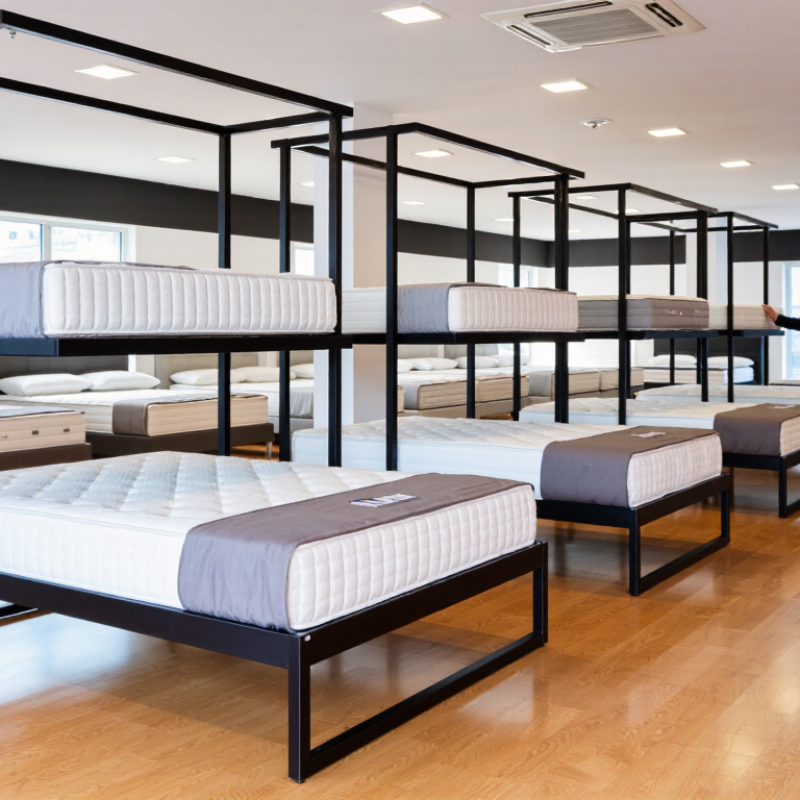
A mattress is difficult to judge from a product page alone. Shoppers want to press the surface, compare firmness, and see the bed at realistic height. That makes the in-store display more than a place to park inventory. It shapes how easily customers can explore each model.

Grand View Research estimated the global mattress market at USD 51.1 billion in 2023 and projected a 6.7% compound annual growth rate from 2024 to 2030. The figure describes the mattress market, not display-rack sales, but it signals a competitive category where the showroom experience matters. A well-chosen Mattress Display Rack can keep floor models accessible, make labels readable, and help staff protect limited showroom space. Small details count. A bulky frame can block a walkway; a low platform can hide a product card.

This guide compares rack capacity, footprint, materials, mobility, safety features, and compatibility with the mattresses you actually sell. Measure the aisle, test the display with a full-size mattress, and check whether customers can approach it from the sides. There is no universal best rack. Store layout and product mix change the answer.

A sourcing note: no verifiable, named expert quotation specific to mattress display racks was included in the materials available for this introduction. Rather than invent a quote or attribute one inaccurately, this guide focuses on measurable selection criteria and clearly identified market data. A useful rack should support browsing—not get in the way.
How to Choose the Best Mattress Display Rack in 2026

Define Display Goals and Measure the Showroom Before Selecting a Rack

Before choosing a mattress display rack, define the shopper’s task. Will visitors compare firmness, sizes, or materials side by side? Start with intent. The U.S. Census Bureau reported that e-commerce represented 16.1% of total U.S. retail sales in the fourth quarter of 2024, seasonally adjusted. A showroom can make the in-person visit useful through clear comparisons and comfortable product access.

Measure the room before reviewing rack specifications. Record each wall, column, doorway, outlet, and existing fixture. Note door swings and the paths shoppers naturally take. Measure the full display footprint, including the mattress, frame, and space needed to move around it. Measure twice. A tape measure can still miss an awkward corner or a crowded turning point, so mark the proposed layout on the floor before ordering.

Match rack capacity to the goal, not just the available floor area. A compact layout may show fewer models but preserve a clear route; a dense layout can make comparisons harder. Keep sightlines open from the entrance, and check that staff can change displayed mattresses safely. Leave breathing room. Treat your measurements as a working plan, then test them with cardboard outlines or a temporary floor mock-up. The first layout may need revision.

Match Rack Dimensions to Standard Mattress Sizes: Queen 60 × 80 in, King 76 × 80 in

For a mattress display rack, match the usable support area to the mattress—not just the rack’s outside frame. Sleep Foundation’s published mattress-size guide lists a queen at 60 × 80 inches and a king at 76 × 80 inches. That 16-inch width difference matters when shoppers compare beds side by side. Measure the actual mattress and rack openings, including rails, brackets, and any retaining lips. Measure twice.

A queen rack needs at least 60 inches of clear support width; a king needs at least 76. The 80-inch length must also remain unobstructed, so check end stops and wall clearance before installation. The International Sleep Products Association’s industry reporting tracks mattress categories and market conditions, while its published category data is not a substitute for measuring a specific rack. Mattress thickness varies, too. Check the rack’s height and load rating against the products you plan to display, then leave room for staff to lift and rotate each mattress. A few inches can decide whether a display feels easy to browse or awkward to handle. Small gap, big trouble.

Check Rated Rack Capacity Against Each Mattress’s Published Weight

When choosing a mattress display rack in 2026, compare its rated capacity with the published weight of each mattress. Check whether the rating applies per shelf, per arm, or to the entire rack. These figures are not interchangeable. A rack rated for 300 pounds overall may not support that weight on one level. Read the specification sheet, not just a product listing. Numbers matter.

Match the capacity to the exact mattress size on display, since larger versions of the same model may weigh more. If several mattresses share a rack, calculate the load for each shelf or support point as directed by the rack maker. Include any display base or added hardware that rests on the rack. Keep the load within the stated rating, and allow the safety margin recommended by the manufacturer. A close match can look fine on paper, but leave little room for error.

Check that the mattress sits evenly on its intended supports; a shifted load can put extra pressure on one side. After installation, inspect the rack for loose fasteners, bent parts, or rocking before placing products on it. A solid appearance is not proof of capacity. If the mattress weight or rack rating is unclear, request the relevant specifications before loading it. It is an easy detail to overlook.

How to Choose the Best Mattress Display Rack in 2026 — Check Rated Rack Capacity Against Each Mattress’s Published Weight

Mattress weights vary by model and materials. These typical ranges are planning references, not specifications for a particular mattress. Before loading a rack, check each mattress’s published weight and compare it with the rack’s rated capacity per shelf. The target shown is an illustrative 25% planning margin above the upper end of each reference range—not a universal safety standard.

Maintain a 36-Inch Accessible Route Under ADA 2010 Standards §403.5.1

How to Choose the Best Mattress Display Rack in 2026

When an aisle forms part of an accessible route, ADA 2010 Standards §403.5.1 generally calls for at least 36 inches of clear width. Treat that as usable space, not a target that a rack can nearly meet. Measure the narrowest point after installation, including mattress overhangs, rack feet, and nearby signs. Small details matter.

Choose a rack footprint that leaves room for the route to stay open during everyday shopping. A low base may still extend into the aisle. Staff carts, loose price tags, and sample pillows can narrow it further. Keep these items outside the measured path. Then recheck after displays change. It’s easy to miss.

A practical check uses a tape measure at several points along the route, especially beside corners and end displays. Record the tightest measurement, and repeat the check when inventory moves. The standard includes limited exceptions, but they have specific conditions; do not assume a short pinch point is acceptable. Rack selection alone does not establish compliance. Have the completed layout reviewed against the applicable accessibility requirements, including local rules. A little caution here may feel fussy, but a drawing can’t show every real-world obstruction.

Compare Rack Materials, Safety Features, Reconfiguration, and Total Cost for 2026

Choosing a mattress display rack in 2026 means weighing material, safety, flexibility, and lifetime cost—not just the ticket price. Steel frames handle frequent repositioning and heavy mattresses well, while wood can create a warmer showroom but may show dents sooner. The U.S. Geological Survey’s Mineral Commodity Summaries 2025 reports that recycled scrap supplies roughly 70% of U.S. steelmaking feedstock. That supports steel’s circularity, but recycled content alone does not prove a rack will last; check welds, finish, load ratings, and replacement-part availability.

Safety details matter around tall, shifting mattresses. Look for stable bases, locking casters, rounded contact points, and clear load limits. OSHA’s materials-handling rule, 29 CFR 1910.176(b), says stored materials must be secured against sliding or collapse. Ask suppliers for test documentation, and check that the rack stays stable when one mattress is removed. Small showroom changes can expose weak designs.

Tips: Price the full lifecycle. Include delivery, assembly, floor protection, maintenance, and reconfiguration labor. Modular rails may cost more upfront but reduce disruption when layouts change. Measure doorways and aisle widths before ordering. Take photos during a real layout change, then note the time and tools required. That estimate is imperfect, but better than assuming every rack will adapt easily.

How to Choose the Best Mattress Display Rack in 2026 - Compare Rack Materials, Safety Features, Reconfiguration, and Total Cost for 2026

Compare common rack construction options for indoor mattress showrooms. Ratings below are relative planning guidance, not product certifications or quoted prices.

Rack type and materials Strengths and trade-offs Safety features to verify Reconfiguration Upfront cost level Relative 5-year total-cost outlook Best fit
Welded steel frame
Steel uprights, rails, and welded joints; finish may be painted or powder-coated.
Rigid construction suits stable layouts and frequent use. A fixed design can be less convenient to alter than a modular system. Check the rated load for each shelf or position, weld quality, sharp-edge protection, floor anchoring requirements, and finish condition. Low to moderate. Some systems allow shelf or rail adjustments, but major layout changes may require new components or professional work. Moderate Often low to moderate
Durable construction may reduce replacement needs; repair or refinishing can add cost over time.
Showrooms seeking a robust, long-term layout with limited planned changes.
Bolted modular steel
Steel frames assembled with bolts, brackets, or adjustable connectors.
Commonly offers a practical balance of rigidity and adaptability. More connections mean more fasteners to inspect and maintain. Verify connector and fastener ratings, use the specified hardware, tighten connections as directed, and anchor the rack if required by its design. High. Sections, rails, or shelf positions can often be changed when compatible parts are available. Moderate Often low to moderate
Reusable components can limit replacement costs when layouts change; account for added parts and labor.
Retailers expecting store resets, assortment changes, or future expansion.
Aluminum modular frame
Aluminum profiles joined with mechanical connectors.
Lightweight sections can be easier to move and reconfigure. Performance depends on profile size, connector design, and the complete system’s rating. Confirm load ratings for the assembled configuration, connector security, bracing, stability, and any anchoring instructions. Do not assume all aluminum frames have the same capacity. High when the manufacturer supports modular changes and replacement connectors are available. Moderate to high Moderate
Reusability may help offset initial cost; specialized connectors or replacement profiles can increase upkeep costs.
Spaces where lightweight handling and frequent layout adjustments matter.
Wood-and-steel hybrid
Steel supports combined with wood shelves, panels, or decorative cladding.
Offers a furniture-like appearance and can coordinate with showroom finishes. Wood surfaces may show wear and require cleaning or repair. Confirm that the load-bearing frame—not decorative panels alone—supports the stated load. Check joint security, edge condition, stability, and anchoring requirements. Low to moderate. Cosmetic panels or shelves may be replaceable, but changes to the overall structure can be less straightforward. Moderate to high Moderate to high
Appearance upgrades can increase initial cost; damaged or worn wood components may need replacement.
Showrooms prioritizing a coordinated, residential-style display.
Custom fixed display
Purpose-designed frame and finishes, often combining metal, wood, or panels.
Can be tailored to a specific room, product range, or customer path. Custom dimensions and finishes may limit reuse elsewhere. Request documented load limits and installation requirements for the final design. Check stability, anchoring, edges, and any locally applicable safety requirements. Low. Changes may require custom fabrication, new parts, or installer involvement. High Often high
May be worthwhile for a permanent, carefully planned layout, but modifications and relocation can be costly.
Stores with a stable floor plan and specific display or architectural requirements.

How to interpret cost: “Upfront cost” and “5-year total-cost outlook” are relative comparisons, not market-price data. Actual cost depends on rack dimensions, capacity, finish, quantity, shipping, installation, maintenance, and local labor. Before purchase, compare written load ratings for the complete configuration, follow the supplier’s installation instructions, and assess floor anchoring and stability for your site.