BLOG

7 Tips for Choosing a BMC Composite Hydraulic Press?

Choosing a Bmc Composite Hydraulic Press is not simply a matter of comparing tonnage and price. The right machine must match the compound, mould design, production volume, and required surface quality. BMC can behave like a stubborn dough when temperature control is poor. It may trap air, flash around the mould, or leave visible flow marks. A press that looks impressive on paper may still waste material on the factory floor.

Composite engineering scholar Dr. Suong V. Hoa offers a useful reminder: “A composite design must survive the manufacturing process.” This principle matters when evaluating a Bmc Composite Hydraulic Press. Buyers should examine pressure stability, platen parallelism, heating uniformity, mould clearance, cycle control, safety systems, and after-sales support. Ask for test data using your actual BMC formulation. Request sample parts, not only brochures. Check how quickly the press reaches its target temperature, and inspect the finished edges under strong light.

There is no perfect machine.

A practical review should also consider maintenance access, energy consumption, operator training, and future mould changes. Some buyers focus heavily on initial cost and overlook downtime. That decision can become expensive. Others select excessive capacity, creating unnecessary energy use and slower movement. The better choice balances force, speed, accuracy, durability, and technical support. These seven tips provide a clear starting point, while leaving room for one honest conclusion: real production trials reveal weaknesses that specifications cannot.
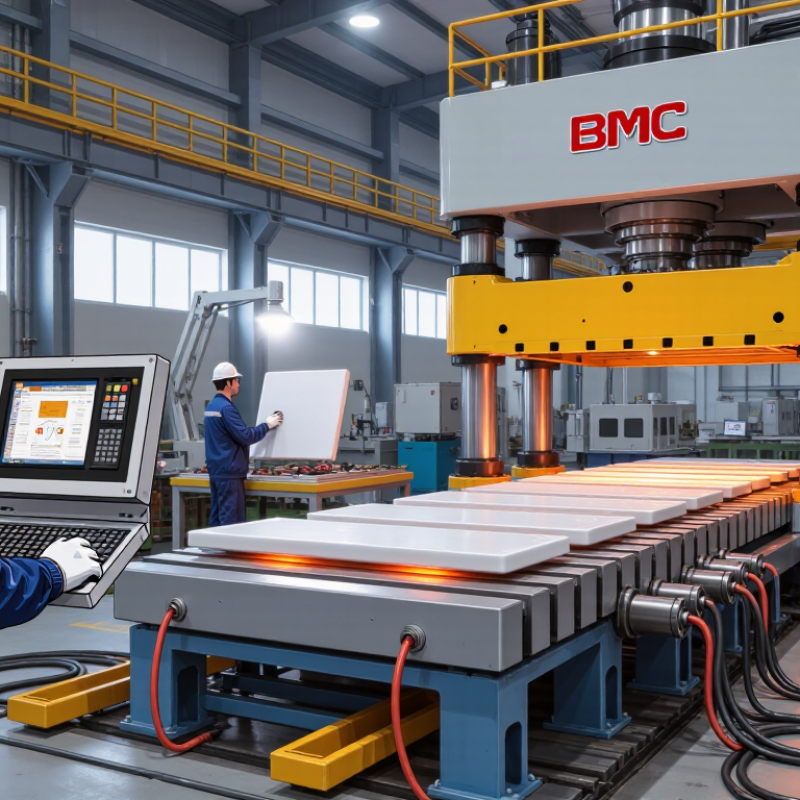
7 Tips for Choosing a BMC Composite Hydraulic Press?

Define BMC Parts by Area, Thickness, Volume, and 5–15 MPa Molding Pressure

Choosing a BMC composite hydraulic press starts with the part, not the machine catalog. Measure the projected molding area, including flash risk and inserts. Multiply this area by a practical molding pressure between 5 and 15 MPa. Then add a sensible safety margin for material variation and uneven loading. A small error here can cause flash, poor filling, or unstable dimensions.

Check part thickness and volume carefully. Thick sections may need slower closing, longer heating, and extra daylight for safe mold handling. High-volume parts require enough shot capacity, reliable dosing, and repeatable platen movement. The mold should sit comfortably on the platen, with space for clamps, ejectors, and operator access. Temperature control matters too. Watch for cold corners, resin sticking, or a dull surface after molding. These details often reveal process problems before inspection data does.

···

A useful press also offers stable pressure control, clear cycle records, and accessible maintenance points. Ask how quickly the system responds when pressure drops during filling. Confirm that the hydraulic system can hold pressure without visible drift. In practice, the first tonnage estimate is rarely perfect. I have seen a compact part need more force because its cavity filled unevenly. Trial molding should challenge the calculation, not merely confirm it. Leave room for tooling changes, future materials, and the occasional design assumption that proves wrong.

Calculate Required Tonnage with Force (N) = Area (mm²) × Pressure (MPa)

7 Tips for Choosing a BMC Composite Hydraulic Press

Choosing a BMC composite hydraulic press starts with a reliable force calculation.

Use Force (N) = Area (mm²) × Pressure (MPa).
For example, a projected molding area of 120,000 mm² at 25 MPa requires 3,000,000 N. Divide this value by 9,806.65 to obtain about 306 tonnes-force. Add a practical safety margin, often 10–20%, after checking the material datasheet and process conditions.

Measure the projected area, not the total part surface. Include runners, overflow zones, and any inserts exposed to molding pressure. Confirm whether the stated pressure means hydraulic pressure or pressure at the BMC cavity. They are not always equal.

Check the press daylight, mold thickness, platen size, stroke, and ejection space. These details can make a correctly sized press unusable.

A real workshop check matters. Inspect pressure stability, platen parallelism, heating control, and cycle repeatability. A slow pressure rise may leave weak edges or incomplete filling. Excessive force can damage the mold, while insufficient force can create flash.

I once treated the calculated tonnage as the final answer; that was too simple. Resin flow, mold wear, temperature, and uneven loading still require review. Keep test records, compare actual pressure readings, and ask the press supplier for verified force and safety data before purchase.

Select 140–170°C Mold Heating and Cure Times for the BMC Grade

Choosing a BMC composite hydraulic press requires more than comparing tonnage. Mold temperature deserves equal attention. Most BMC grades process effectively around 140–170°C, but the exact setting depends on resin chemistry, filler content, and part thickness.

The 2024 MarketsandMarkets composites outlook projects steady global growth above 6% annually through 2030. That pressure increases the need for repeatable molding cycles. In practice, I recommend starting near 150°C, then checking the supplier’s cure curve. A thin electrical housing may cure in 60–90 seconds. Thicker structural parts can require several minutes. Do not trust the timer alone. Verify hardness, dimensional stability, and surface finish after demolding.

Temperature uniformity matters greatly. A 10°C difference across the mold can create uneven curing, warpage, or visible flow marks. The CompositesWorld 2024 market report identifies automotive and electrical applications as major composite demand areas, where consistency remains critical. Install calibrated sensors near the cavity, not only inside the heater plate. One practical mistake is using the displayed temperature as the actual mold temperature. I have seen this create false confidence. Recheck it with an independent probe.

Cure time should be adjusted in small steps, such as 10 seconds. Record pressure, temperature, part weight, and defect location. A longer cycle is not always safer. Excessive heating may damage inserts or reduce surface quality. The best setting is the shortest cycle that achieves stable cure, complete filling, and reliable release.

Verify Platen Parallelism, Daylight, Stroke, and ISO 6020/2 Hydraulics

Choosing a BMC composite hydraulic press requires more than comparing tonnage. Platen parallelism deserves a documented measurement. Place calibrated indicators at several platen points, then record variation under light and working load. Even a small tilt can create uneven BMC flow, thin edges, or premature mold wear. I would also inspect the platen surface after heating. Thermal growth can change the result.

Check daylight and stroke against the complete mold stack, not an estimated height. Daylight must allow loading, inserts, and safe removal without awkward handling. Stroke should reach full mold closure while leaving practical adjustment room. Too little travel causes setup delays. Too much travel may reduce efficiency and complicate guarding. These details are easy to miss during a quick quotation.

For hydraulics, request clear evidence of ISO 6020/2 compatibility, including cylinder dimensions, mounting details, seals, and rated operating conditions. Confirm that the pump, valves, hoses, and pressure controls match the cylinder’s real duty cycle. Ask for test records, calibration dates, and maintenance access. A neat specification sheet is not enough. I would question any supplier that cannot explain pressure stability during a long cure. One imperfect assumption can become a costly production habit.

7 Tips for Choosing a BMC Composite Hydraulic Press? - Verify Platen Parallelism, Daylight, Stroke, and ISO 6020/2 Hydraulics

Reference values are typical engineering checkpoints for BMC compression molding. Final requirements should be confirmed against the mold, material datasheet, and applicable safety standards.
Tip Selection Dimension Typical Reference Data Why It Matters for BMC Molding Recommended Verification
1 Required press force Calculate projected molded area × cavity pressure, then add a practical safety margin. Many thermoset compression applications fall in the approximate range of 2–8 tons per square inch of projected area, depending on geometry, material, flow length, and process conditions. Insufficient force can cause flash, incomplete filling, or poor dimensional control. Excessive force may increase mold stress and energy consumption. Use the mold drawing and BMC supplier data to calculate projected area. Confirm that the selected press has sufficient rated tonnage and an appropriate pressure-control range.
2 Platen parallelism A practical factory acceptance target is often specified in the range of 0.05–0.15 mm over the working platen area, but the exact tolerance must come from the mold and product requirements. Parallel platens promote even pressure distribution, uniform part thickness, consistent flash, and reduced mold deflection. Measure at multiple points with calibrated precision indicators or a laser measurement system. Test with the platens unloaded and, where specified, under a representative load.
3 Daylight opening Required daylight should include mold height, part-removal clearance, inserts, insulation, and a process allowance. A common planning allowance is 50–100 mm above the calculated minimum, subject to the mold design. Adequate daylight allows safe mold loading, unloading, cleaning, insert placement, and removal of finished BMC parts. Compare the press daylight range with the complete mold stack height. Check both maximum daylight and the minimum closed height with the required shut height.
4 Ram stroke and approach speed The stroke must cover mold opening, part ejection, and operator or automation access. Hydraulic presses commonly use a separate rapid-approach speed and a slower pressing speed; the exact values are machine-specific. A suitable stroke reduces cycle time while preventing collision with inserts, lifters, or robotic handling equipment. Verify usable stroke rather than nominal stroke. Run a dry-cycle test with the actual mold, checking approach, pressing, decompression, return, and safe access positions.
5 Hydraulic system and ISO 6020/2 compatibility ISO 6020/2 defines mounting dimensions for compact hydraulic cylinders and is commonly associated with 160 bar nominal pressure. The standard does not by itself define the entire press hydraulic circuit. Correct cylinder dimensions, seals, pressure ratings, and connection details support reliable force generation and maintainability. Request cylinder bore, rod diameter, rated pressure, seal material, port size, mounting dimensions, and hydraulic schematic. Confirm that all components are rated for the intended operating pressure.
6 Temperature and process control BMC compression molding commonly uses heated molds, with many thermoset formulations processed approximately between 130–180 °C. The actual range depends on the resin system, filler package, and material supplier. Stable mold temperature affects cure rate, flow, surface quality, shrinkage, and final mechanical properties. Specify independent heating zones, temperature sensor locations, control accuracy, heat-up time, and platen insulation. Validate temperature uniformity across the mold face using calibrated sensors.
7 Control, safety, and repeatability The control system should record force or pressure, position, temperature, dwell time, and alarm status. A repeatable production cycle should maintain stable values within limits defined by the process validation plan. Traceable process data helps identify flash, voids, under-cure, over-cure, dimensional variation, and equipment drift. Check two-hand controls or guarded operation, emergency stops, pressure relief, light curtains or interlocks, recipe access, data export, calibration records, and repeatability across multiple cycles.

Assess Safety, Energy Use, ASTM D790 Testing, and UL 94 Fire Ratings

When choosing a BMC composite hydraulic press, inspect safety hardware before comparing speed. Look for guarded platens, interlocked doors, emergency stops, and clearly marked pressure controls. Two-hand operation can reduce hand exposure near closing tools. Pressure relief protection matters when a valve sticks. A quiet pump is not automatically a safe pump.

Energy use deserves practical testing. Compare motor power, standby consumption, heating time, and oil temperature during repeated cycles. Variable-displacement pumps may reduce wasted power during holding periods. Check for leaks around fittings and cylinders. Small leaks become expensive over long production runs. I once focused too heavily on maximum force and overlooked idle energy. That was a poor comparison.

For ASTM D790 work, confirm that the press can hold steady force and controlled displacement. Accurate fixtures, correct span length, specimen dimensions, loading rate, and conditioning affect flexural results. Record force and deflection continuously, not only at failure. A powerful press cannot correct poor alignment. For UL 94 fire ratings, verify the tested material grade and specimen thickness. Horizontal and vertical methods produce different classifications. Review afterflame time, flaming drips, and cotton ignition results. Molding temperature and fiber distribution can change performance. Ask for traceable test reports, but inspect the actual production material too. Paperwork alone can hide process variation.