BLOG
Top 10 Parent Roll Tissue Paper Manufacturers Worldwide
The global tissue market depends on a quiet foundation: reliable Parent Roll Tissue Paper. These large reels feed converting lines that produce toilet tissue, facial tissue, napkins, and household towels. A minor defect can create visible wrinkles, uneven embossing, or costly machine stoppages.
This article examines ten leading Parent Roll Tissue Paper manufacturers worldwide. The selection considers production capacity, fiber quality, moisture control, reel consistency, delivery performance, and environmental practices. It also considers regional access. A supplier near a converter may reduce freight risk, even when another producer offers a lower quoted price.
Tissue-industry consultant Rodger Fuller has described the principle clearly: “Quality is not inspected into tissue; it is built into every process step.” That view remains practical. Operators watch basis weight, tensile strength, softness, and winding tension throughout production. A clean reel edge matters. So does dependable technical support after shipment.
The companies discussed here serve different markets. Some focus on premium virgin-fiber grades. Others produce cost-efficient recycled or hybrid materials. Several invest in energy recovery, water treatment, and certified forestry systems. Certifications can strengthen confidence, but they do not replace factory performance or transparent communication.
No ranking is flawless. Buyer priorities change by country, product type, and equipment design. A manufacturer praised for softness may not suit a high-speed napkin line. Likewise, a strong export supplier may face longer transit times. This guide offers a practical starting point, not a final purchasing decision. Actual trials, laboratory testing, and supplier audits still matter.
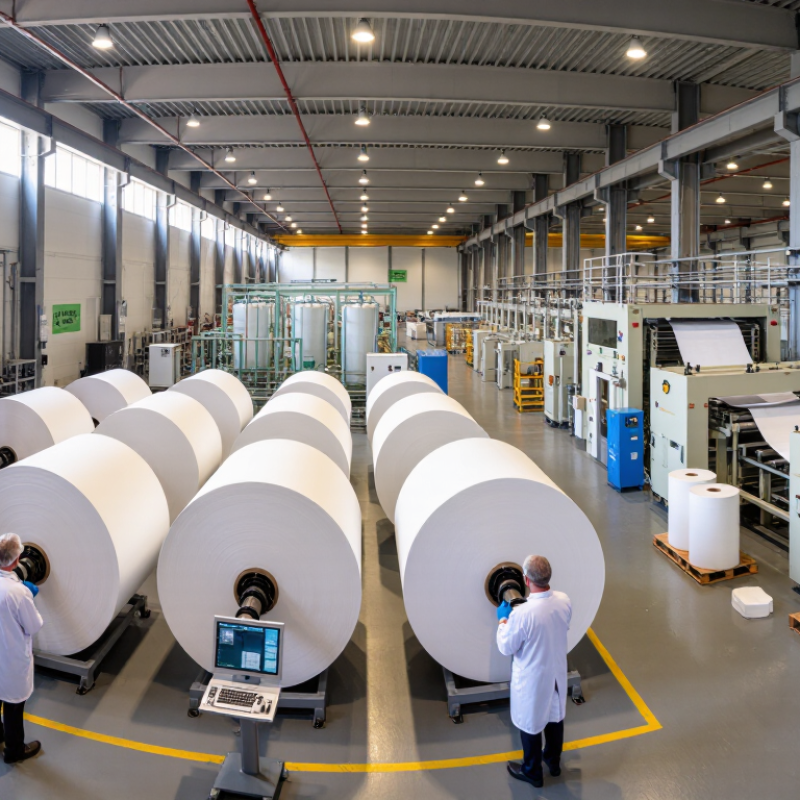
Parent Roll Tissue Paper: Definition, Uses, and Production Process
Parent roll tissue paper is the large, unfinished web produced before converting. Converters unwind it, cut it, emboss it, fold it, or print it into finished products. These include toilet tissue, facial tissue, kitchen towels, napkins, and medical wipes. Roll width, basis weight, softness, strength, and moisture resistance determine its suitability.
The process begins with virgin fiber, recycled fiber, or a controlled blend. Pulp is mixed with water, cleaned, refined, and formed on a moving screen. A press section removes water. Then, a Yankee dryer removes more moisture while a creping blade creates stretch and softness. Rewinding produces large parent rolls with stable tension. The 2024 Smithers tissue outlook places global tissue consumption above 40 million tonnes annually. FAO and UNECE reported global paper and paperboard production near 420 million tonnes in 2023, showing the scale of the wider fiber industry. However, reported tissue figures vary by method and region.
Tips: Check moisture uniformity across the roll. Test tensile strength in both directions. Inspect the edge for wrinkles and crushed cores. A lower basis weight may reduce cost, but it can increase breakage during converting. That trade-off is often underestimated. Recycled fiber can improve resource efficiency, yet it may reduce softness or cleanliness if poorly screened. Experienced buyers should request laboratory data, trial rolls, and batch traceability before approving regular supply.

Parent Roll Tissue Paper: Typical Basis Weight by End Use
Basis weight, measured in grams per square metre (GSM), is a key specification of parent rolls. The values below show representative industry ranges used for common tissue products; actual specifications vary by quality, converting process, and market.
Lower GSM grades are commonly selected for softness and flexibility, while higher GSM grades provide greater absorbency, strength, and durability.
How the Top 10 Manufacturers Are Selected and Compared
Top 10 Parent Roll Tissue Paper Manufacturers Worldwide
The top ten manufacturers are selected through a transparent, evidence-based process. Public records, factory audits, technical documents, and verified customer feedback provide the starting point. Production capacity matters, but it does not tell the whole story. Evaluators compare parent roll width, basis weight, moisture levels, softness, tensile strength, and converting consistency. Samples should be tested under similar conditions. Otherwise, the comparison becomes weak.
Delivery reliability is also measured. Reviewers examine lead times, export experience, packaging quality, and response speed when problems occur. Environmental performance includes fiber sourcing, water management, energy use, and documented certifications. Financial stability and after-sales support add further confidence. Still, no score is perfect. A manufacturer may look efficient on paper, yet perform differently during peak demand. That gap deserves careful attention.
Tips: Request recent test reports and production samples. Ask how quality is controlled during shift changes. Check whether specifications remain stable across several shipments. Compare total landed cost, not only the quoted roll price. Keep written records of defects, delivery dates, and corrective actions. Small details matter. Personal experience can reveal issues that spreadsheets miss, although one buyer’s result should not define an entire manufacturer.
Top 10 Parent Roll Tissue Paper Manufacturers Worldwide - How the Top 10 Manufacturers Are Selected and Compared
| No. | Evaluation Dimension | Weight | Public Evidence Reviewed | Comparison Method | Why It Matters |
|---|---|---|---|---|---|
| 1 | Parent Roll Production Capacity | 20% | Published mill capacity, machine count, annual reports, and official production disclosures. | Manufacturers are compared by verified annual tissue capacity and the ability to supply jumbo parent rolls consistently. | Large, stable capacity supports continuity of supply and large-volume converting programs. |
| 2 | Product Range | 12% | Technical data sheets covering virgin, recycled, hybrid, facial, toilet, towel, napkin, and specialty tissue grades. | The range is assessed by basis weight, softness, strength, absorbency, color, and intended end use. | A broader grade portfolio enables buyers to source multiple applications from one qualified supplier. |
| 3 | Fiber Sourcing and Traceability | 12% | Chain-of-custody certificates, recycled-fiber declarations, supplier policies, and published sourcing procedures. | Higher scores are assigned where fiber origin, recycled content, and chain-of-custody documentation are independently verifiable. | Traceability helps buyers manage responsible sourcing, regulatory, and customer requirements. |
| 4 | Quality Management | 12% | ISO 9001 certification, laboratory testing procedures, product specifications, and quality-control statements. | Comparison focuses on documented quality systems, testing frequency, roll consistency, and complaint-control procedures. | Consistent basis weight, moisture, caliper, tensile strength, and softness reduce converting problems. |
| 5 | Environmental Performance | 12% | ISO 14001 or equivalent systems, environmental reports, water and energy targets, and emissions disclosures. | Publicly reported resource-efficiency targets and independently certified systems receive stronger scores. | Pulp and paper production are resource-intensive, so efficiency and emissions management affect total impact. |
| 6 | Manufacturing Footprint | 10% | Public mill locations, export markets, regional warehouses, and disclosed logistics capabilities. | Manufacturers are compared by geographic coverage and proximity to major converting and consumption markets. | A diversified footprint can shorten lead times and reduce dependence on a single production site. |
| 7 | Technical Customization | 8% | Available jumbo-roll widths, diameters, core options, basis-weight ranges, and private specification support. | Scores reflect the number of configurable parameters supported without compromising product consistency. | Correct roll dimensions and performance specifications improve machine efficiency for converters. |
| 8 | Food, Hygiene, and Safety Compliance | 6% | Product-contact declarations, hygiene-management systems, applicable test reports, and regulatory statements. | The review checks whether compliance documentation is current, product-specific, and suitable for the target market. | Documented safety controls are essential for tissue used in personal care, food-service, and institutional applications. |
| 9 | Export and Supply Reliability | 5% | Export-market information, delivery policies, packaging specifications, and publicly documented customer-service capabilities. | Comparison considers international shipping experience, order flexibility, packaging protection, and continuity planning. | Reliable delivery protects converter production schedules and reduces emergency purchasing. |
| 10 | Transparency and Market Reputation | 3% | Corporate reports, certification databases, technical publications, trade-association records, and independently verifiable disclosures. | Only claims supported by current, publicly accessible evidence are included in the comparison. | Transparent information makes supplier qualification and ongoing risk assessment more reliable. |
| Total Weighted Score | 100% | The final ranking should be based on documented evidence, comparable product specifications, and the latest available information. | |||
Global Profiles of the Top 10 Parent Roll Tissue Paper Manufacturers
The leading ten parent roll tissue manufacturers show how geography shapes production strategy. A North American integrated producer often combines pulp and tissue operations, supporting stable supply and large export volumes. A Scandinavian mill typically emphasizes certified forests, low-temperature drying, and measured energy use. Western European specialists focus on premium softness, controlled bulk, and narrow moisture variation.
An Iberian manufacturer may benefit from efficient port access and flexible converting partnerships. A Turkish producer often serves nearby markets with short delivery routes and mixed-fiber recipes. High-capacity Chinese mills compete through automation, rapid machine changes, and extensive domestic distribution. Japanese operations are commonly associated with precise winding, clean-room discipline, and consistent roll dimensions.
A Southeast Asian supplier may connect agricultural fiber resources with expanding regional demand, although land-use claims require careful verification. Latin American producers often combine plantation management, modern pulp technology, and strong export infrastructure. A Middle Eastern manufacturer can use its central logistics position to serve several import-dependent markets, but freight exposure remains a concern.
Public rankings are imperfect. Capacity alone does not prove reliability. During supplier assessments, buyers should examine machine age, basis-weight tolerance, core compression, dust levels, and delivery records. Factory visits can reveal details that brochures miss, such as uneven roll edges or poorly protected warehouse stock. Renewable energy statements also need supporting data. The strongest profiles are transparent about limitations, maintenance delays, fiber sources, and measurable quality results.
Production Capacity, Product Quality, and Regional Market Coverage
Choosing among the top 10 parent roll tissue paper manufacturers requires more than comparing annual output. Production capacity should match your converting schedule, storage space, and seasonal demand. A mill with wider machines can supply larger jumbo rolls, but capacity alone does not guarantee dependable delivery. During plant audits, buyers should review machine age, maintenance records, backup lines, and average lead times. A small delay can stop an entire converting operation.
Product quality needs measurable evidence. Check basis weight, moisture content, tensile strength, softness, roll diameter, and core accuracy. Samples should run through actual rewinding equipment, not only pass a laboratory test. Clean edges matter. So does stable winding. Quality teams should also inspect pulp sourcing records, batch traceability, and applicable management certifications. I have seen attractive samples fail during high-speed converting. That mistake is expensive.
Regional market coverage affects flexibility. Suppliers serving Asia, Europe, North America, the Middle East, Africa, and Latin America may offer local warehouses, export experience, and multiple shipping routes. Buyers should verify port access, customs documentation, language support, and emergency replenishment plans. A global network can reduce risk, yet it may weaken personal service. This deserves reflection. The best manufacturer is not always the largest; it is the one balancing capacity, consistent quality, and practical support for your market.
Industry Trends, Sustainability Practices, and Future Developments
Top 10 Parent Roll Tissue Paper Manufacturers Worldwide
The top ten parent roll manufacturers face a sharper sustainability test. Buyers now examine fiber origin, energy use, water intensity, and transport emissions. Smithers’ 2024 tissue market outlook identifies premium hygiene demand and sustainability as major growth drivers. However, market growth alone does not prove responsible production.
Recycled fiber remains important, but it is not a universal solution. CEPI reported a 79.3% paper recycling rate in Europe in 2023. Tissue mills still need fresh fiber for strength, softness, and hygiene performance. Responsible producers therefore combine certified virgin pulp with carefully tested recycled inputs. Some mills also use closed-loop water systems, heat recovery, and electric forklifts. Small changes matter.
The next development may be smarter, not simply larger. Digital sensors can monitor moisture, basis weight, and energy consumption during parent roll production. Artificial intelligence may reduce trim waste and unplanned downtime. Yet these systems require capital, skilled operators, and reliable data. Many sustainability claims remain difficult to compare because reporting boundaries differ. That weakness deserves more attention. Future leaders should publish independently verified figures, including kilograms of CO2 per tonne, cubic metres of water used, and the percentage of recycled fiber. Performance must be visible at mill level, not hidden behind broad corporate promises.