
BLOG
China Top 10 Food Inspection Machine Manufacturers
Selecting among China’s top 10 food inspection machine manufacturers calls for more than comparing brochures. A capable food inspection machine can detect metal fragments, inspect products by X-ray, check package seals, or verify weight on a fast production line. But performance depends on the product, packaging, line speed, and maintenance—not just the sensor. Small details matter. A misshapen pouch or a dense ingredient can change inspection results.
The public-health stakes are substantial. The World Health Organization’s 2015 report, Estimates of the Global Burden of Foodborne Diseases, estimated that 600 million people worldwide became ill from contaminated food each year, with 420,000 deaths. These figures underline why reliable inspection and documented quality controls matter. Food-safety expert Frank Yiannas has said, “Food safety is not a competitive advantage; it is a basic consumer expectation.” His point applies to equipment decisions, too: detection claims should be tested against real products and operating conditions.
This guide compares manufacturers through practical criteria, including technology range, application support, calibration, service availability, and integration with existing lines. It also considers whether suppliers explain testing methods clearly, rather than relying on impressive specifications alone. No machine catches every risk. That limitation deserves attention, not marketing gloss. Buyers should request product trials, sample reports, and references from comparable factories before making a decision. The strongest choice is not automatically the most expensive or the most familiar; it is the system that performs consistently in the buyer’s actual production environment.
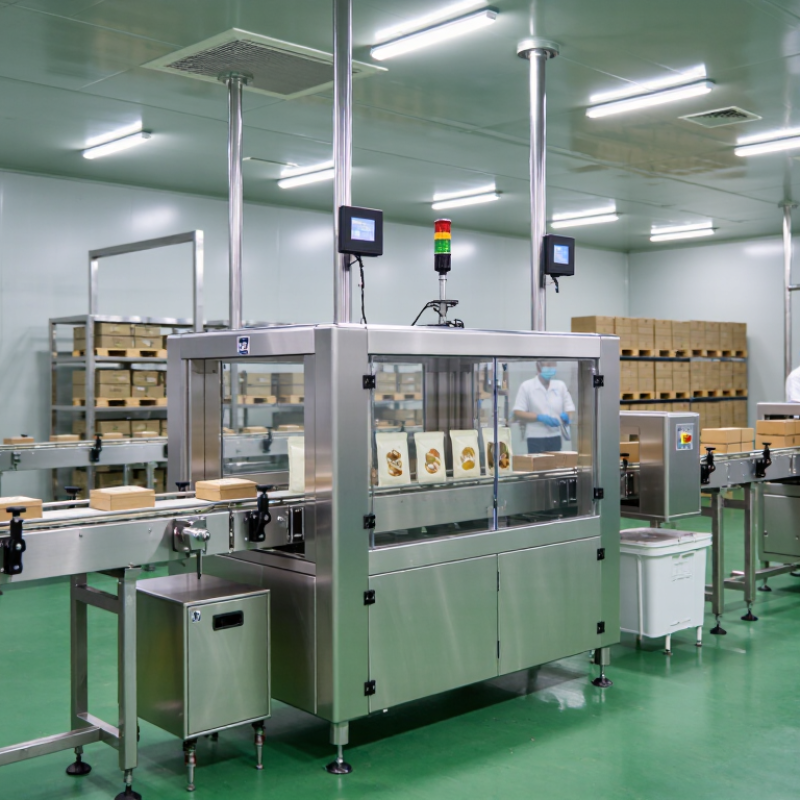
What Food Inspection Machines Do and How They Work
Food inspection machines check products as they move along a production line. Different systems look for different problems. Metal detectors create an electromagnetic field and signal when conductive metal disrupts it. X-ray systems compare density across an image, helping identify some foreign objects, such as metal or glass. Performance depends on the product, contaminant, and inspection settings.
Cameras can examine labels, color, shape, and package seals. Checkweighers measure each item as it crosses a moving belt. When a unit fails a set limit, a timed air jet or pusher removes it from the line. Not magic. Operators need to test detection performance with suitable test pieces and check that rejected items reach the correct bin. Product residue, vibration, and changing package materials can affect results. A clean-looking screen is not proof that every defect was caught. Reviewing reject records and inspecting equipment regularly can reveal patterns, but no single machine detects every possible issue. The setup often needs adjustment when recipes or packaging change.
China Top 10 Food Inspection Machine Manufacturers - What Food Inspection Machines Do and How They Work
A technology-focused overview of common food inspection machine types, their operating principles, applications, and practical limitations. This table describes equipment categories rather than ranking or identifying manufacturers.
| No. | Machine Type | What It Inspects | How It Works | Common Applications | Practical Considerations |
|---|---|---|---|---|---|
| 1 | X-Ray Inspection System | Detects foreign bodies and product irregularities that create a detectable difference in X-ray absorption, including many metal fragments, stones, and glass pieces. | X-rays pass through the product to a detector. Software analyzes differences in image intensity and flags items that exceed configured inspection criteria. | Packaged foods, canned goods, bakery products, meat, seafood, and products on production lines. | Detection depends on contaminant size, density, orientation, product composition, and line setup. It does not identify every material or guarantee detection of every foreign body. |
| 2 | Metal Detector | Detects metal contaminants, commonly ferrous metals, non-ferrous metals, and stainless steel, depending on the detector and application. | A product passes through an electromagnetic field. A metal object changes the signal, prompting an alarm or automatic reject mechanism. | Packaged and unpackaged foods, including meat, snacks, dairy products, and dry ingredients. | Moisture, salt, temperature, packaging, and product conductivity can affect sensitivity. Product-specific testing and calibration are important. |
| 3 | Checkweigher | Checks whether the weight of an individual package or item falls within configured limits. | A conveyor carries each item over a weighing section. The measured weight is compared with the target range, and out-of-range items can be rejected. | Packaged foods, portioned products, bottles, trays, and cartons. | It verifies weight, not product composition or contamination. Accuracy depends on line speed, vibration, package spacing, and correct setup. |
| 4 | Machine-Vision Inspection System | Checks visible features such as shape, color, surface defects, fill level, label position, date-code presence, and package appearance. | Cameras capture images under controlled lighting. Image-processing software compares features with programmed rules or reference images. | Fresh produce, baked goods, confectionery, bottles, jars, labels, and printed packaging. | Performance depends on camera resolution, lighting, product presentation, and the inspection criteria. It generally cannot see through opaque packaging. |
| 5 | Optical Color Sorter | Separates individual pieces based on observable color, shape, or other optical differences. | Items travel through a viewing area where cameras or optical sensors assess them. Air jets or mechanical gates divert pieces that meet reject criteria. | Grains, nuts, seeds, dried foods, coffee beans, and selected fruits and vegetables. | Sorting depends on how consistently items are presented and on contrast between acceptable and rejected pieces. Internal defects may not be visible. |
| 6 | Package Leak Tester | Checks package integrity for leaks or inadequate seals using a method suited to the package type. | Methods may include vacuum decay, pressure decay, or other controlled pressure tests. The system monitors pressure changes that may indicate a leak. | Flexible pouches, trays, bottles, and other sealed food packages, depending on equipment design. | Test method and sensitivity must be matched to the package material, shape, headspace, and acceptable leak criteria. |
| 7 | Seal Inspection System | Inspects package seal appearance and, in some systems, checks seal-related defects such as wrinkles, contamination, or incomplete closure. | Cameras or sensors examine the seal area and compare its appearance or measured features with defined acceptance limits. | Heat-sealed pouches, lidding films, and tray or cup packaging. | Visual inspection can identify visible seal issues but does not necessarily prove that a package is hermetically sealed. Leak testing may be needed for integrity verification. |
| 8 | NIR Composition Analyzer | Estimates selected product properties, such as moisture, protein, or fat, when the product and measurement method have been validated. | Near-infrared light interacts with the sample. The instrument analyzes the reflected or transmitted spectrum using calibration models. | Grains, flour, dairy, meat, and other products where suitable calibration models are available. | Results are model-based estimates. Representative calibration samples, product consistency, and periodic validation are important. |
| 9 | Hyperspectral Imaging System | Assesses spatial and spectral characteristics that may help identify selected quality differences or defects not readily distinguished by ordinary color imaging. | The system captures image data across multiple wavelength bands. Software analyzes spectral signatures and their location across the product. | Research and specialized sorting or quality-control applications for produce, grains, meat, and other foods. | Applications require suitable equipment, validated models, and controlled operating conditions. It is not a universal detector for all contaminants or quality defects. |
| 10 | Magnetic Separator and Detector | Uses magnetic fields to capture or remove susceptible ferrous metal particles from product streams. | Product passes near a magnet or magnetic assembly, which attracts ferrous particles for removal or collection. | Powders, grains, dry ingredients, and processing lines where ferrous-metal control is appropriate. | Magnetic separation targets magnetic materials and is not a substitute for equipment designed to detect non-ferrous metals or other foreign bodies. |
Related Posts
-
2026 Best Food Inspection Machine Buying Guide
-

Top Varpe Checkweigher Suppliers for Global Buyers?
-
Top 10 Food X Ray Inspection Equipment Manufacturers?
-
Why Is Food Xray Inspection Essential for Global Buyers?
-
How to Choose a Food Xray Inspection System in 2026
-
China Top Food Inspection Machine Manufacturers?
